This trip to London has involved a lot of new experiences for us, mixed in with some old favourites. Paul has faithfully recorded our daily adventures and I’ll try not to duplicate anything.
Some of the things that stand out for me from our first week include unexpected new offerings at each of our favourite museums; expanding my horizons with more modern artists and getting to know some locals as we wonder around; new museums; and learning, always learning more about the world we live in; and of course, revisiting some of my favourites.
Cricket has always been a mystery to me. We’ve seen it on TV and played informally on other trips, but it never made any sense. A ball gets hit into left field, the only movement is between the wickets (stumps) and suddenly someone has scored 4 points or 6 points. Huh?
Enter Alex, a charming grad student we met in a local park. We had stopped to watch an informal game, he stopped by, and in response to my questions gave us a delightful summary of the basics of the game.
Lots of similarity to baseball: batsman/batter; bowler/pitcher; a ball caught on the fly is an out. Then there are the stumps (I had always called the wickets). Knock them over the batsman is out. There are boundaries and getting a ball past the boundaries without it being a fly-out and you score – four runs if it’s a grounder, six runs if it flies over the boundary before it hits the ground.
I must admit I still don’t understand this score – England 156/3 (39.3 over) that appeared after today’s first game of the fourth test, but I do know that The Ashes which are being contested now refers to actual ashes in an urn, the Stumps burned and delivered to England the first time Australia actually beat England and which are now contested on a regular basis.
And I believe that even though the test isn’t over, the contest has been won by the English who are quiet giddy with their success . . . smiles.
If you want to know a bit more about cricket and why it is such an obsession here, read this (and I now get the joke in the title of the article which, without Alex’s help I wouldn’t have):
http://www.telegraph.co.uk/men/thinking-man/11782887/Stumped-by-cricket-Dont-worry-youre-not-the-only-one.html
Alex
We not been to The British Museum before and whilst talking to Alex, who is studying ancient history and spends a lot of time there doing research, we asked what he would recommend. His immediate response was the Elgin Marbles, and so that was our first stop the day we visited there.
Being an avid reader of British fiction I’d seen the term Elgin Marbles long before I had any idea what they were. You might imagine what was conjured in my mind by that name. But I had long since learned that the marbles were panels and statues brought to England by Lord Elgin from Greece. I even probably knew they were mostly from the Parthenon.
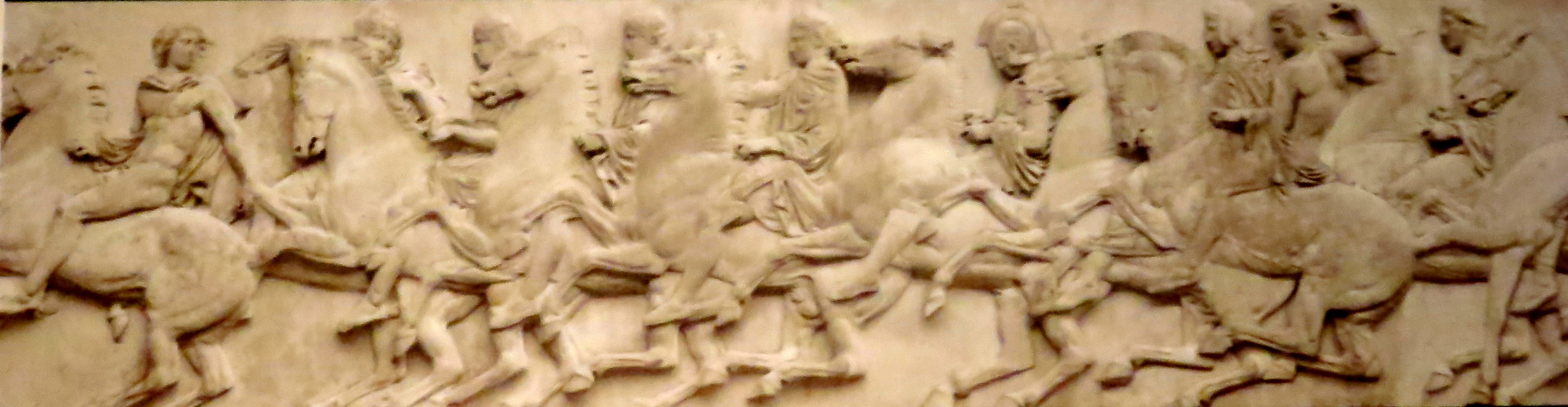
I had hoped to see and compare the artistry of the Roman and Greek statues, but alas, most of the Greek statues were not on offer. The history and description of the panels from the Parthenon was still fascinating and the panels give much insight into what the full blown statues would be like. Did you know that the marble panels were originally painted, so that the figures stood out against colored backgrounds, emphasizing the exquisite forms that marched across the length and breadth of the building.
As we see it now: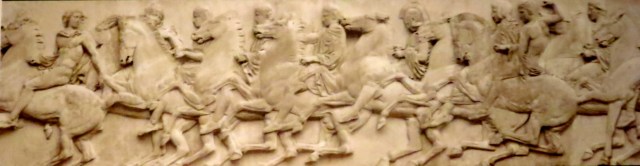
As it may have been: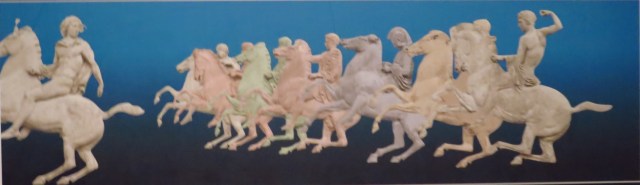
Thanks for reading. More posts to come . . .
Jean

















 Travels With Picasso