Visiting with a friend

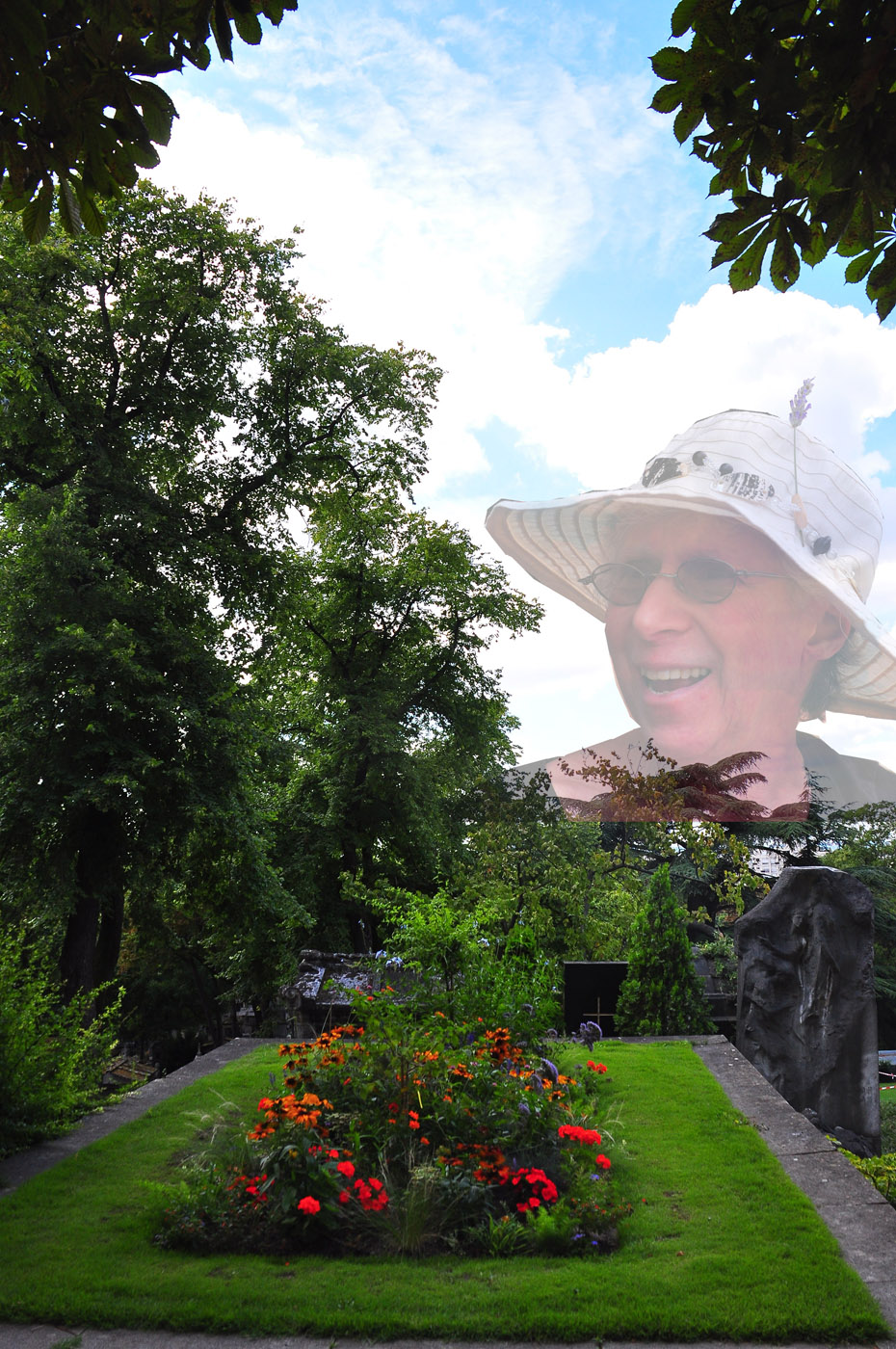
Yesterday we visited with the spirit of our friend, Elli.  It was the anniversary of her death according to the Jewish Calendar.  Her ashes are scattered on the Charonne side of Pere Laschaise, scattered to enrich the flora that thrives there amidst the monuments to the souls who have moved on.

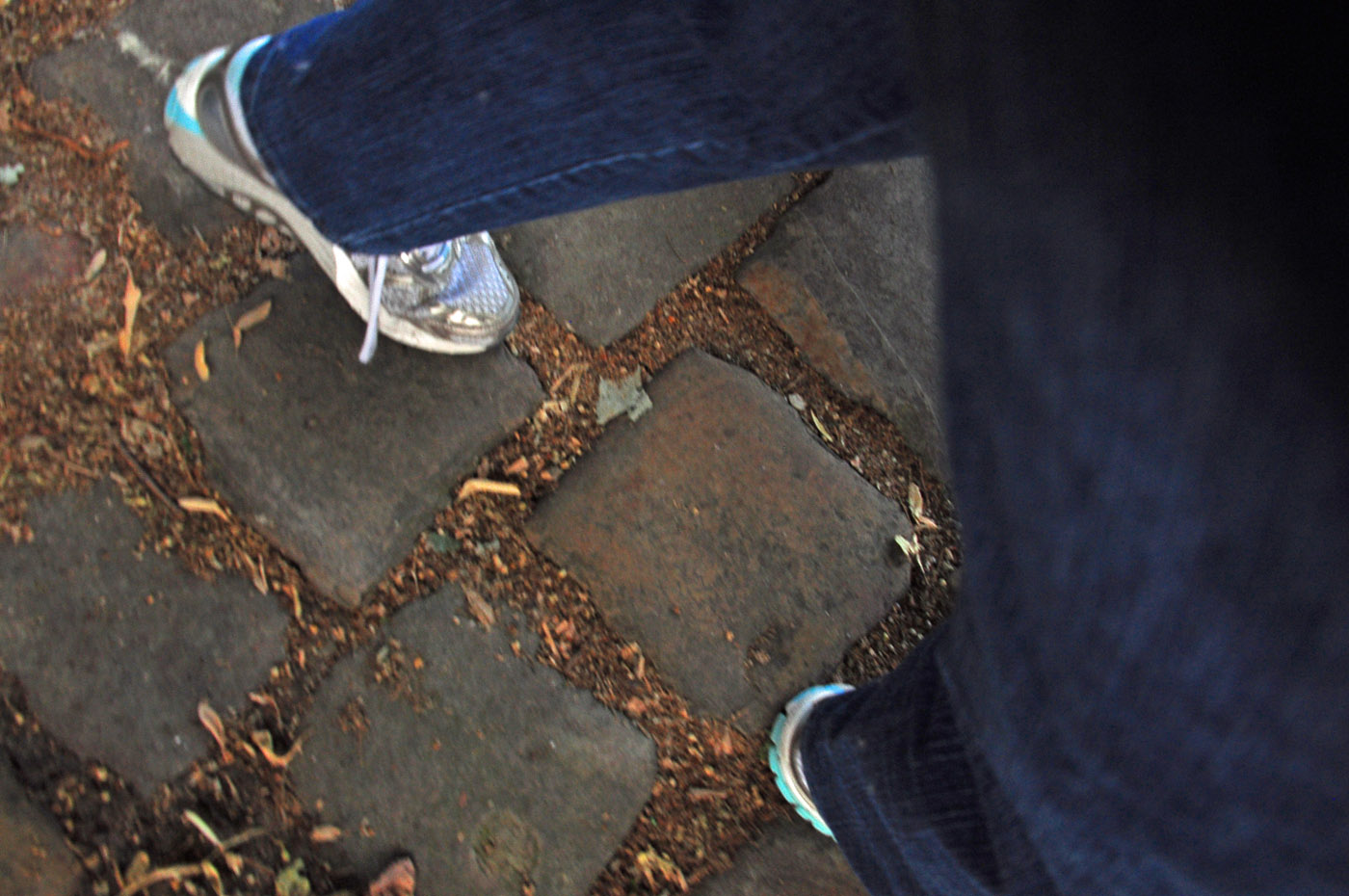
Elli, Stopping by to say hello

Elli, Stopping by to say hello

She was happy to see us and stopped by to say hello.  As always, she made me laugh and made me think.

When we got home I found she had taken a picture with my camera.  I think she wanted to remind me to watch my step on those pesky cobblestones.

A Reminder From Elli

A Reminder From Elli

Thanks, Elli.

Posted in Friendship, Jean's Posts, Paris | Tagged , , , | 4 Comments

Pere Lachaise

Yesterday was the Jewish calendar anniversary of our good friend Elli’s death. Her ashes are scattered on the gardens of Pere Lachaise so we decided it was a fitting place for us to remember her. We walked along the cobblestone lanes, climbed rough steps to the hills, and stopped at the gardens to remember the wonderful times we shared with Elli and JP, her smile, her sense of humor, and her incredible strength of character.

This slideshow requires JavaScript.

We framed our perambulations by seeking as many artists’ memorials as possible. This took us all over the cemetery. There were a couple we failed to find, but it was a lovely way to guide our way through magnificent place.

This slideshow requires JavaScript.

In the evening Jean cooked a delicious meal of her chipotle raspberry chicken breast and yam hash and we shared a quiet dinner with JP. A great end to a lovely day.

Paul

Posted in Art, Travel | Tagged , , , , , , , , , | 2 Comments

Musee d’Orsay, Sennelier Art Store, and a Walk Along the Seine

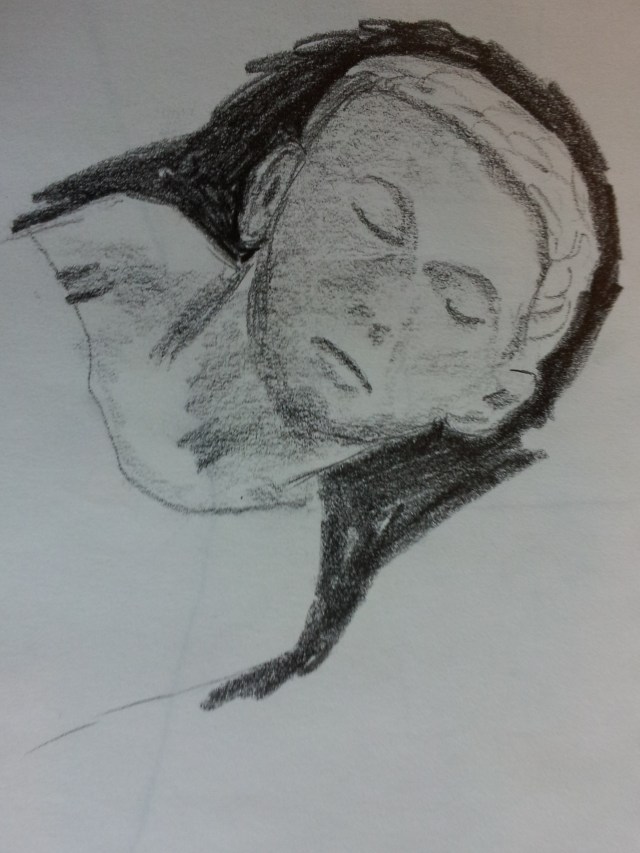
Yesterday we returned to the Orsay Museum to complete our tour. The lines were short on this Friday morning, so we only waited about 30 minutes. Our first stop was to return to the Odilon Redon pastels for Jean to fill her senses with this artist’s strong colors and unique use of pastel. Then we returned to the Hays Collection to review some pieces and finish the final room that we had missed earlier. That room contained many drawings by one of my favorite artists, Aristide Maillol. These sketches are primarily in red pastel on paper. Most of them are of his favorite subject, female nudes. They were beautiful. I would have loved to sit with my sketchbook and tried to copy them, but the crowds of people in the small rooms prevent such artistic endeavor. To read more about Marlene and Spencer Hays and their love of French art click on their names. However, while Jean was viewing Redon I did manage to find space in the central hall of the museum to sit down and sketch the head of one of the statues – a sleeping boy.

Sleeping Boy

After leaving the museum we sought out a restaurant recommended by Christopher Kimball from Cook’s Country. One of its specialties is chocolate mousse. However, the restaurant was closed for renovation, a common August occurrence in France. We settled for macaroons and tea at a local patisserie.

Jean noted that we were quite close to the famous art store, Sennelier, which we have visited in the past. A few blocks of walking brought us to their front door and Jean began to explore the banks of drawers filled with thousands of pastel colors. Sennelier pastels aren’t the only item available. They sell several other brands of pastels, pencils, oils, acrylics, watercolor, papers, pens, inks, and much more. The gentleman who asked Jean if she needed assistance was Monsieur Sennelier himself. He is the third generation to own the store.

While Jean was looking at pastels I wandered the store. A woman had heard us talking to Monsieur Sennelier and said to me, “I was born and raised in Seattle.” That initiated a conversation with Alissa Warshaw, an artist from Los Angeles. Click on her name to see her website and beautiful drawings. I like the simple clean lines of her work. We chatted about art for some time and then parted to continue browsing this wonderful shop.

Soon I encountered a couple who were testing colored pencils. Lindsay Broughton is an Australian artist who also teaches drawing. Some of his work can be seen at either of these underlined links.  His evocative drawings have a great deal of depth. Lindsay said he works very large these days – wall size. With Lindsay was Jane Quon, an installation artist also from Tasmania. Jane is on Facebook and LinkedIn for those of you who are on those sites. Jane blends art and science, particularly marine science, into large scale installations around the world. What a privilege to meet these terrific artists.

We headed for the Metro and our ride home. That took us along the Seine for a couple of photos.

This slideshow requires JavaScript.

Dinner with JP completed our day. C’etait merveilleux!

Paul

Posted in Art, Travel | Tagged , , , | 2 Comments

Musee d’Orsay and Sketching in the Park

Yesterday we spent the day at the d’Orsay Museum. Photos are no longer allowed there, so this will be a image-less post. After a full day we decided that at least one, maybe two more days will be required to see what we want to see. (Not the entire collection.)

There are three special shows at the moment and two of them are included in the general admission. Wow! First Felicie de Fauveau blew me away. This exhibit of this 19th century female scupltor entitled The Amazon Sculptress is fantastic. This woman’s work is astounding, collected by museums all over the world, and little known due to her gender in a century where it mattered. Her work in marble, brass, and terra cotta is extremely evocative. Her self portrait sculpture from 1846 won a national prize and is unbelievable. She was my artistic find of the day.

The second special exhibit is the Marlene and Spencer Hays Collection. These rich Americans have amassed a collection of French art from the 19th and 20th centuries. They particularly like drawing, so there are a number of drawings from famous artists. Voulliard, Denis, Redon, Fantin-Latour, Tissot, Caillebote, Corot, Derain, Morisot, Eva Gonzales, Matisse, Modigliani, Bonnard, Ranson, Roussel, Degas, Renoir… It must be nice to be rich and have these decorating your dining room, living room, bedroom and boudoir. They have loaned the collection from both their Nashville and NYC homes to this special exhibit. It was quite a unique experience to get to see these masterpieces. Who knows when it will happen again? It closes next week. We are very lucky to have been here for this show.

We did see much of the 19th century collection, but did not have time for impressionism or post-impressionism. That remains for the next several days.

Today Jean went to visit a famous international pastel company about which I will let her tell the story. I went to a local park for sketching. Here is one of my sketches from the day, ink and wash. This is the sort of sketch that Maillol did for practice. Go out, find an interesting leaf, and draw it. I also did a number of quick sketches of people in the park, but they rarely stood still long enough for more than a few lines to catch a gesture or pose. A great couple of days!

20130808_194623[1]

Posted in Art | Tagged , , , , | 1 Comment

Women of l’Orangerie

After two days of rest, visiting with JP, and doing laundry we ventured across the city yesterday to visit Musee de L’Orangerie. This museum houses Monet‘s Waterlilies masterpiece. The artist himself designed the space where the 8 massive canvases cover the walls. It is a tour du force of impressionism. Silence is the rule in the two chambers and no photographs are allowed. This was a change from 2011 when we snapped pictures freely. Museum curators seem to change the photography rule at will without explanation.

The basement of the museum houses a collection put together by Paul Guillaume in the early 20th century. It covers approximately 1880-1930. This collection is one of the best we have seen anywhere, particularly for that period. Mr. Guillaume had impeccable taste and the money to buy the best. He wanted to establish a museum of modern art, but died before accomplishing that desire. His wife completed the task, ceding the collection to the State in 1959.

How does one summarize a collection that includes Rousseau, Modigliani, Laurencin (the only female artist in the collection), Matisse, Picasso, Derain, Cezanne, Renoir, Soutine, and Utrillo? There are portraits, still lifes, landscapes, and much more. As I wandered the rooms I noticed that most of the artists portrayed women in some way. Therefore, here is my slide show of The Women of l’Orangie. If you want to see the still lifes and landscapes you will have to come to Paris. I have only included the artists’ names as captions to save having to type all the painting titles.

This slideshow requires JavaScript.

After our visit to l’Orangerie we went into The Tuileries for some refreshment. Our tea and sandwich arrived with a thunderstorm, so we took shelter under an awning with a lovely couple from Great Britain. We chatted with Keith and Sheila Moore for some time about art, gardening, and retirement. (Three of us are already retired and Keith is about to at the end of the year.) Soon we parted company after exchanging addresses.

In the evening JP accompanied us to a return visit to a fabulous Indian vegetarian restaurant we dined at in 2011. Krishna Bhavan is worth a visit if you are in Paris. Whether you are vegetarian or not, if you like Indian food, this is the place for you. We enjoyed a lovely dinner and then walked back to the Metro for the ride home.

Today we are staying close to the apartment doing blog posts (this one), painting, and will be going to a small soiree at the local public garden. This is sort of like a P-Patch in a small vacant corner lot nearby. Our friend Elli was involved with this garden before she died last year. Jean and I visited the garden and met several of the gardeners in 2011. JP has continued to be involved with the garden. Tonight they are having a get together with apertifs to which we have been invited with JP.

Posted in Art, Retirement, Travel | Tagged , , , , , , , , , | 2 Comments

Arrived in Paris – What about Dutch painting?

Johannes Vermeer, The Milkmaid (1658–1660)

Johannes Vermeer, The Milkmaid (1658–1660) (Photo credit: Wikipedia)

Yesterday we traveled by Thalys train to Paris. Like all other trains we’ve ridden in Great Britain and The Netherlands it was a very pleasant experience. We did arrive more than an hour late because the train stopped for a signal system failure. The crew’s abundant apologies were unnecessary as far as we were concerned. We were happy that they stopped and waited for it to be fixed!

We called JP from the taxi to let him know we were on our way across the city. He met us with hugs, kisses, and wine. We shared a simple cold chicken and cucumber salad dinner on this hot evening. Did I mention that it was 99 F when we arrived? Fortunately this morning it seems to have cooled during the night. I am up early to go to the Charonne Market with JP.

JP commented on my previous post and asked why Dutch painting is not my favorite. No, I have not explained my cool reaction to much Dutch painting. First let me say that there is a wide variety of styles, techniques, etc. represented by the last several centuries of Dutch painting. It isn’t fair to categorize them together. Some of the art I love, some I dislike, and some I respect the artist’s talent, but don’t adore their work. After visiting the Vermeer exhibit in London and the Rijksmuseum‘s overview of Dutch painting it became clear to me that Vermeer and Rembrandt stood out from their contemporaries. Many of the old Dutch masters‘ works do not grab me, but these two do. Likewise, I do not prefer most painting from the romantic period of the 1700 and 1800’s. However, there are notable exceptions where romantic artists deviated from their colleagues and make a statement that compels me to look deeply. Turner is the most obvious in this sense.

What sets the ones I love apart from their contemporaries that don’t attract my attention?

First, they all use light dramatically. They like strong contrasts between light and dark and aren’t afraid to push those extremes a bit beyond nature. Rembrandt’s paintings next to other painters of the period demonstrate his use of what I call the spotlight effect. Others also used dark backgrounds, but they usually fully lighted the subject. Rembrandt carefully created shadows and dark places on the subject. He seems to have paid more attention to the supposed source of light and what it would do to the subject. Turner, of course, took the lessons from Italian painters and painted with wonderful backlighting. The sun is often directly in view in his paintings and he knows this means the viewer must be almost blinded by the light. Vermeer used soft light to show the delicate edges that shadows have. While also using extremes of light and dark to create drama.

Second, most of the painters in the Dutch school use sharp edges and distinct lines. That is, their subjects are explicitly drawn, almost like a photograph. I have never liked this sort of realistic art. It does not represent how our eyes see the world. When we look at an object all the rest of the world that is in our peripheral vision becomes fuzzy. That is what Rembrandt, Vermeer, and later Turner and a few others of early painting understood and incorporated into their work. You see the main object in focus and surrounding objects become less focused. There are exceptions. For instance in Night Watch Rembrandt painted everyone in focus. However, he used light to differentiate the few people he wanted to emphasize. It creates a visual effect of blurring the shadowed figures, so the effect to the viewer is much the same as if he had used fuzzy edges and indistinct lines. Their contemporaries painted the entire scene in focus with sharp edges and clean lines. It gives a crisp image. Later in the 19th century the impressionists went to almost all fuzzy edges and focused solely on light and color.

Third, I love texture. Most of the old Dutch masters used very thin paint applied in multiple washes. The result is a very flat, shiny painting that sometimes doesn’t even show brush strokes. Brush strokes show me the artist’s energy, direction, and intent. Many artists use palette knives and other tools to give more body to their painting. Some go so far as to almost sculpt the paint on the canvas. Turner’s painting are vibrant because of his use of light, but also because of the texture he achieved. I found that Rembrandt and Vermeer, unlike most of their contemporaries, were able to mimic texture through the ways they applied the washes. Using color and tone they were able to show a stubbled face as if the paint was sticking out from the canvas or make us feel the soft nap of velvet. However, most of their contemporaries didn’t do this as well in my opinion.

That in a nutshell is my best explanation for why I don’t go gaga over many of the old masters’ works. Light and dark value contrasts, differential focus, and texture are the aspects that attract me to a painting. Thanks for asking JP!
Posted in Art | Tagged , , , , , | 2 Comments

Rijksmuseum

Today we visited the rebuilt Rijksmuseum. The walk along the canal from our hotel to the museum is relatively short and pleasant. The building itself is quite beautiful. Most of all we loved their handling of the crowd of people coming in. We entered fairly quickly and efficiently, waiting only a few minutes to get our tickets.

What can one say about the art? It takes your breath away. Rembrandt, Vermeer, Van Gogh (yes, more of him), and many other famous artists astound the senses. However, it was some Dutch artists with whom I was unfamiliar that surprised me. We don’t hear much about the Dutch Impressionists, but they existed and made some wonderful art. All day I heard my teacher Howard Hansen in my ear telling us to look at the wonderful drawing skills and how they use dark and light. I’m learning every day, Howard!

Here are a few paintings of the 100 or so I took. There are too many to sort and post in one evening. You must come to Amsterdam and see for yourself!

This slideshow requires JavaScript.

Tomorrow we catch the train to Paris. We look forward to visiting JP and returning to our favorite haunts in the City of Light. Here are some Rembrandts to say goodnight.

This slideshow requires JavaScript.

Posted in Art, Travel | Tagged , , , , | 3 Comments

Travel to Amsterdam and Overdosing on Van Gogh

We’ve been offline for a few days. On Monday we lounged around London before catching an evening train to the Harwich ferry terminal. There we boarded our Stena Line  overnight ferry to The Netherlands. It was a long and tiring trip. We didn’t sleep well on the ferry and had to stand in line for quite a while for immigration on both ends. We were exhausted when we reached our hotel Tuesday morning.

This slideshow requires JavaScript.

Our hotel in Amsterdam is a block from the city’s biggest park. It has miles of walking trails, lakes, birds, fishermen, and lots of cyclists. We spent Tuesday afternoon exploring the park.

37% of Amsterdam residents ride bikes so they are everywhere on the streets, sidewalks, and in the park. We have yet to see a bike with low slung handlebars. Everyone rides upright. I assume it’s the only way to see cars, mopeds, and pedestrians clogging the streets and paths.

This slideshow requires JavaScript.

Today we went to the Van Gogh Museum. It is about a mile walk from our hotel. We stood in line for and hour and a half for tickets. Having advance tickets could have cut that in half, but don’t guarantee immediate entry either. The museum is organized for maximum efficiency of moving as many people per day as they can. There are few places to sit and you move along without time to stop and contemplate a painting. I found myself thinking of Temple Grandin and wondering if she might help them make this a more pleasant experience. For those who don’t know her work, click on her name to understand my reference. Anyway, enough complaining, after all there were a hell of a lot of Van Gogh’s to see. Surprisingly there also were a number of wonderful pieces by other artists of the period who were his friends and teachers. Most striking to me were his sketches in pencil, ink, crayon, etc. They really show his creative process. Here are some of them.

This slideshow requires JavaScript.

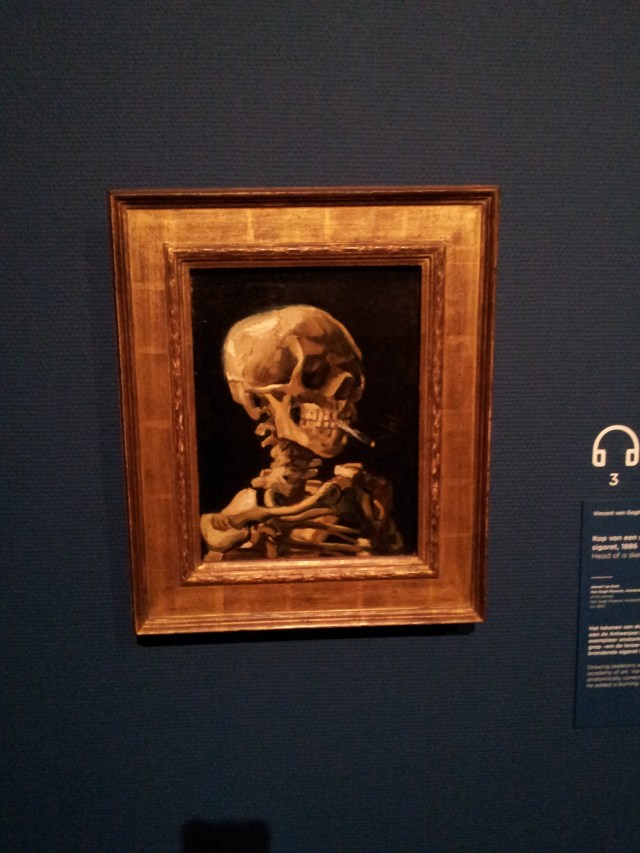
Finally, perhaps the most surprising painting in the museum was this one of a skull smoking a cigarette. It looks like something out of a modern anti-smoking campaign. I would love to know what he intended with this image.

A most unusual Van Gogh image

A most unusual Van Gogh image

Our day ended with an overdose of hot Indonesian food. It was fantastic! Now to bed.

Paul

Posted in Art, Travel | Tagged , , , , , , | 1 Comment

V&A and The National Gallery

Yesterday we visited the Victoria and Albert Museum. Unlike 2011, this time we saw a bit more than paintings. However, the Turner and Constable paintings took a great deal of time. Of particular interest are the 90 Constable “sketches” that are mostly oils on paper. Wow! We took in a short concert by the Choir With No Name, a choir of homeless people. They gave us inspirational contemporary music with great gusto. While Jean finished her tour I went to the garden for coffee (yes, I’ve taken up the habit) and did some sketching. A couple of wonderful British ladies joined me for a chat and then Jean came down. We had a lovely visit, but I seem to have forgot to write down their names. If you are reading this out in Kent, please let us know. We thoroughly enjoyed our visit.

Today we returned once more to the National Gallery. Jean went up into the rooms to sketch and I sat in the coffee shop to sketch. Unfortunately, people just don’t stay put long enough to do more than quick gestures. It was fun. We also saw a wonderful mime on the square. Then we took a walk down to Embankment, a beautiful little park along the Thames, and on to our tube.

Dinner tonight at Bella Italia, which has become our London go-to place. Good food, reasonable prices, and friendly staff. Tomorrow we’re off to Amsterdam.

This slideshow requires JavaScript.

Posted in Art, Travel | Tagged , , , | 1 Comment

Reinterpreting Cardinal de Retz

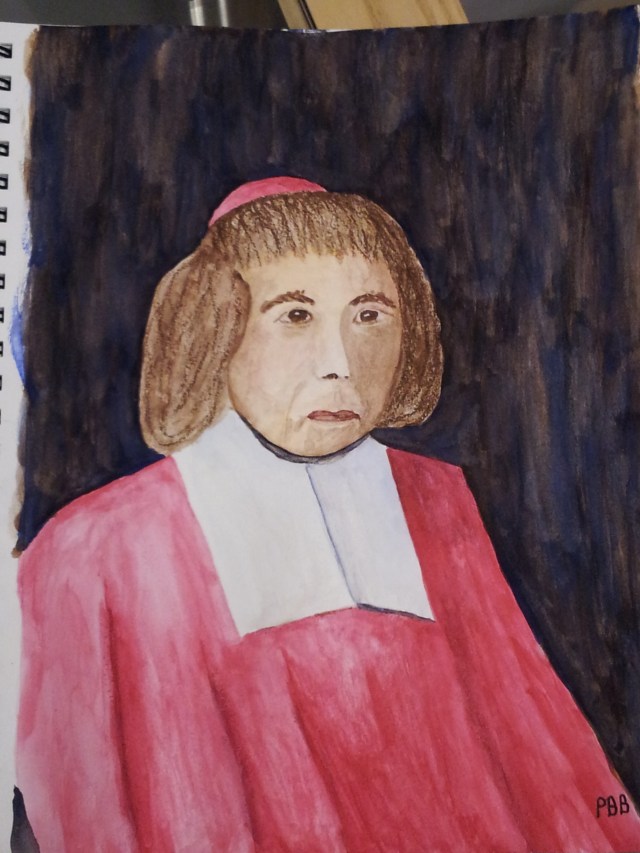
Yesterday I painted a watercolor interpretation of Jacob Ferdinand Voet’s Cardinal de Retz from memory and my pencil sketch. In my image he is a younger man, but still dour.

20130726_142843

Posted in Art, Travel | Tagged , | 4 Comments